

Last Updated: November 15, 2026
Quick Summary
The best roofing materials for London homes are natural slate and clay tiles for period and conservation-area roofs, concrete tiles for budget re-roofs on modern homes, and metal, EPDM or GRP for flat and low-pitch roofs. Match the covering to your roof pitch, structure and street context rather than choosing on price alone.
- Natural slate suits Victorian and Edwardian terraces but is heavy, so the roof structure must carry it.
- Clay tiles match period homes but chip and crack under foot traffic, and old profiles can be slow to match.
- Concrete tiles are quick to lay and budget-friendly but can look out of place on sensitive period streets.
- In conservation areas, planning rules often require natural slate, clay tiles or lead work to match the original.
- EPDM is a seamless rubber membrane for flat roofs, staying flexible in cold weather over a sound deck.
Table of Contents
- Comparing the Best Roofing Materials for London Homes
- Natural Slate Roof Pros and Cons
- Clay Roof Tiles for Period Homes
- Concrete Roof Tiles Lifespan and Value
- Metal Roofing and EPDM for Flat Roofs
- Roofing Materials for Conservation Areas
- Matching Roofing Materials to London Housing Types
- Book a Roof Survey Before You Choose
- Frequently Asked Questions
Comparing the Best Roofing Materials for London Homes
Choosing between the best roofing materials for London homes comes down to four things: your roof pitch, the age and structure of the building, any conservation-area rules, and how long you plan to stay. This guide from Doctor Roofing compares slate, clay, concrete, metal and flat-roof coverings on cost, lifespan and suitability. Below, we break down what works on London housing stock and where cheap choices can cost more later. The Federation of Master Builders’ UK roofing materials comparison is a useful starting point for material and installation cost categories, though it does not quote figures for individual roofs. Because flat-roof coverings suit different pitches and structures from slate or tile, roofing materials for flat roof extensions deserve a separate comparison when planning an addition.
Quick Comparison: Cost, Lifespan and Best Use
| Material | Relative Cost | Typical Lifespan | Best For |
|---|---|---|---|
| Natural slate | High | Longest | Period homes, conservation areas |
| Clay tiles | Medium to high | Long | Victorian and Edwardian pitched roofs |
| Concrete tiles | Low | Medium | Budget re-roofs on modern homes |
| Metal | Medium | Long | Low-maintenance pitched and flat roofs |
| EPDM | Low to medium | Medium to long | Flat roofs, extensions, garages |
No honest roofer quotes a figure before seeing your roof. Cost depends on access, scaffolding, the state of the battens and felt, and whether lead work needs replacing. For a full breakdown of what moves the number, read our guide to the factors that set the cost of roof replacement.
Natural Slate Roof Pros and Cons
Natural slate is a traditional covering for London’s Victorian and Edwardian terraces, and it suits a period street. The main drawback is weight, so the roof structure must be able to carry it. Artificial and fibre cement slate offer a lighter, cheaper slate-style look, and Lynch Brother Homes’ UK roofing material guide notes these alternatives can undercut concrete tiles on price.
Clay Roof Tiles for Period Homes
Clay roof tiles are the natural fit for period homes, particularly Victorian and Edwardian terraces where the original roof was clay. They age gracefully, hold colour, and match neighbouring properties, which matters if your street has a consistent look. The trade-off is fragility: clay chips and cracks under foot traffic, so repairs need care, and matching old profiles can be slow.
Concrete Roof Tiles Lifespan and Value
Concrete roof tiles are widely available and modern interlocking profiles are quick to lay. The look is more uniform than clay. On a modern London home or a budget-driven re-roof where appearance is not the priority, concrete tiles make sense. On a period terrace in a sensitive street, they can look out of place and may not satisfy conservation officers. Value for money depends entirely on the building they sit on.
Metal Roofing and EPDM for Flat Roofs
Metal and flat-roof coverings matter on London housing stock, where many extensions, garages, bay roofs and post-war blocks rely on a flat or low-pitch covering.
Metal roofing
Metal roofing covers a broad family, and the specification matters more than the label. The common options are:
- Steel sheet with a metallic or granular coating, lightweight, quick to install, and suitable for pitches as low as around 10 degrees depending on the profile and fixing detail. It is the usual choice for agricultural and some commercial buildings, and appears on domestic extensions where a low pitch rules out tiles.
- Aluminium standing seam, formed on site or in the factory into long panels with raised seams. It handles low pitches well, has no exposed fixings, and is often used on contemporary extensions and flat-to-low-pitch roof conversions.
- Zinc and copper, traditional metals with a long pedigree on London buildings, including church roofs and some Victorian commercial premises. They develop a patina over time and are usually specified where appearance and longevity justify the cost.
- Metal tile panels, steel panels pressed to imitate clay or concrete tiles. They are lighter than the tiles they mimic and faster to lay, which can suit a re-roof where the structure cannot take extra weight.
Two practical points decide most metal specifications. First, weight: most metal systems are significantly lighter than concrete or clay tiles, which can avoid structural strengthening on older roofs. Second, pitch and fixing: each system has a minimum pitch and a specified fixing pattern, and installing below that minimum is a common cause of leaks and wind uplift.
Watch out: metal roofs expand and contract with temperature, so fixings and seam details must allow for movement; a rigid fixing on a long run can work loose or distort the panels.
EPDM and flat-roof coverings
For flat roofs, EPDM (ethylene propylene diene monomer) rubber membrane is a common modern choice. It is supplied as a single seamless sheet, remains flexible in cold weather, and is straightforward to install over a sound deck.
The alternatives are worth knowing:
- GRP (glass-reinforced plastic) fibreglass, a rigid, seamless system that is popular on domestic flat roofs and balconies. It performs well when the deck is sound and the detailing is careful, but it is less tolerant of movement than EPDM.
- Reinforced bitumen membrane (felt), the traditional built-up system, usually in two or three layers. It is cost-effective but has a shorter service life than EPDM or GRP and is more vulnerable to ponding and UV degradation.
- Single-ply PVC, similar in concept to EPDM, with different welding and detailing requirements.
The catch with any flat roof is the detail, not the membrane. See our flat roofing service for new and replacement flat roofs across London.
Roofing Materials for Conservation Areas
Conservation areas change the decision. In these streets, planning rules often require materials that match the original roof, which usually means natural slate, clay tiles, or lead work on valleys, flashings and chimneys. Synthetic substitutes that look similar may still be refused. Before ordering anything, check with your local planning authority and, if the property is listed, seek consent. Victorian terraces commonly have original lead work. Our guide to repairing lead work on a Victorian terrace explains what that job involves.
Matching Roofing Materials to London Housing Types
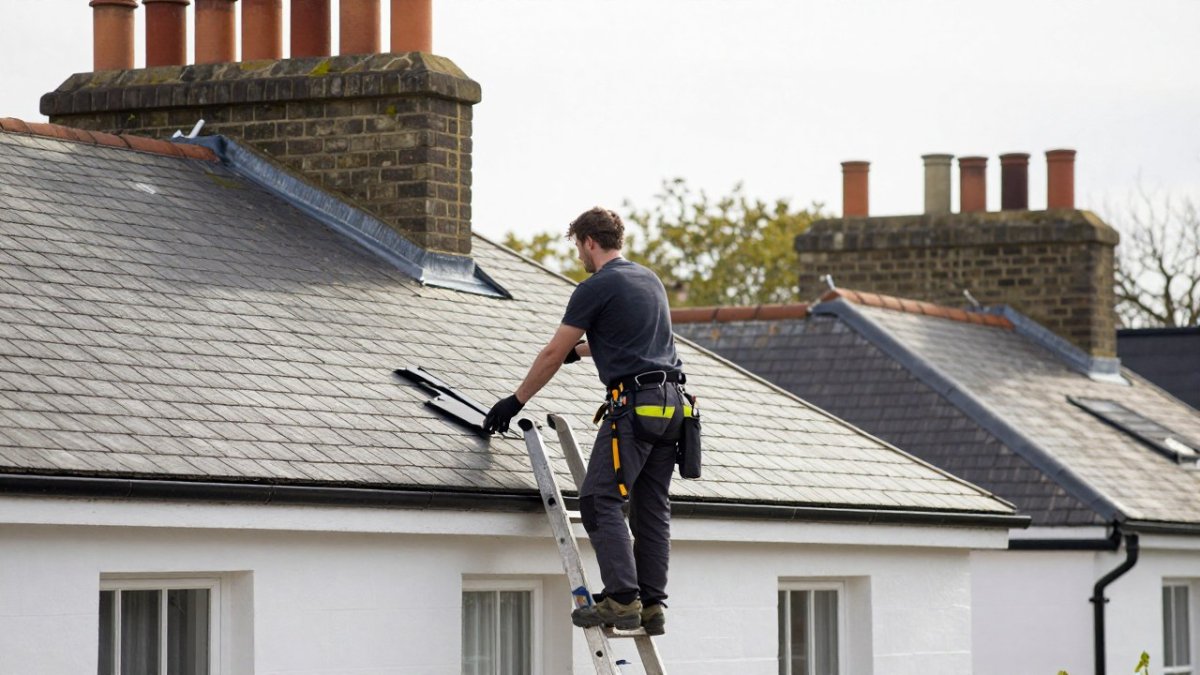
Match the material to the building, not the other way round. Most material guides stop at a generic table; the useful question is which covering actually suits the roof you have, given its pitch, structure and street context.
Victorian and Edwardian terraces
These are the dominant period housing type across much of inner London. The original roofs were typically natural slate on a pitched timber structure, with lead valleys, lead flashings and brick chimney stacks. The roof pitch is usually steep enough for slate, and the structure was designed for the weight of slate.
- Best fit: natural slate, or a good-quality artificial slate where budget or weight is a constraint. Clay tiles appear on some later Victorian and Edwardian roofs, particularly where the original specification was tile rather than slate.
- Structural note: the roof was designed for slate, so replacing slate with concrete tiles adds weight and may require structural checks. Replacing slate with a lighter artificial slate or metal is usually the safer direction.
- Planning note: in conservation areas, matching the original slate and lead detail is often the simplest route through planning. Synthetic substitutes that look similar may still be refused.
Thirties and post-war semis
Inter-war and post-war semis commonly have clay or concrete tiles on a pitched roof, often at a slightly lower pitch than the Victorian terraces. The roof structure is usually designed for tile weight.
- Best fit: clay tiles where appearance and longevity matter, concrete tiles where budget is the priority. Both are straightforward like-for-like replacements.
- Structural note: these roofs are generally less sensitive to tile weight than period slate roofs, but the battens and felt are often at the end of their life and should be assessed at the same time.
Post-war and modern homes
Later twentieth-century and contemporary homes often use concrete tiles, interlocking profiles or lightweight metal on pitched roofs, and single-ply or GRP membranes on flat roofs and extensions.
- Best fit: concrete tiles or lightweight metal on pitched sections; EPDM, GRP or single-ply on flat sections. These roofs are usually designed around the weight and fixing pattern of the original covering, so a like-for-like replacement is the lowest-risk route.
- Structural note: modern roofs are often designed to tighter tolerances, so adding a heavier covering is rarely sensible without a structural check.
Blocks of flats and extensions
Blocks of flats, rear extensions, bay roofs and garages usually rely on flat or low-pitch coverings. Access, drainage falls and the number of penetrations (vents, flues, rooflights) drive the specification more than the membrane brand.
- Best fit: EPDM or GRP on domestic flat roofs; single-ply systems on larger communal roofs. Metal standing seam is worth considering where a low pitch and a long run make membrane joints a risk.
- Practical note: on densely built streets, access for scaffolding and disposal is often the biggest constraint on the project, not the material choice.
London-specific conditions
London’s heat, rainfall and urban pollution all argue for materials with good weather resistance and a maintenance plan, not just a low headline price.
A common pattern is that the material is blamed for a failure that actually originates in the ventilation, the flashings or the drainage. Before choosing a covering, it is worth having the roof structure, ventilation and drainage assessed together.
Book a Roof Survey Before You Choose
Materials perform best when fitted to a suitable roof structure, correctly ventilated and properly flashed. If you are weighing up a full replacement, our roof replacement service covers pitched, flat and conservatory roofs, and we strip back to the rafters and rebuild to current Building Regulations. You can get in touch to arrange a survey.
A roof is only as good as the survey behind it. If your roof is leaking, storm-damaged or simply past its best, guessing at materials wastes money.
Frequently Asked Questions
What is the best roofing material for a period home?
It depends on the property. Natural slate suits many Victorian and Edwardian terraces because it matches the original covering and handles London rainfall well, while clay tiles are common on older suburban homes. What matters most is matching the existing roof pitch, structure and any conservation area rules. A surveyor or roofer should confirm the roof can carry the weight of the material you choose before work starts.
Are slate roofs better than tiled roofs?
Natural slate is heavier, so not every roof structure can take it. Clay and concrete tiles are common alternatives. For a period home in a conservation area, slate often wins on appearance and planning compliance; for a tight budget on a modern roof, tiles are the practical choice.
How long do roof tiles and slates last?
Lifespan depends heavily on installation quality, maintenance and how well the roof is ventilated.
Can you change the roofing material on an older property?
You can, but check planning first. In a conservation area or on a listed building, changing the material, colour or profile may need consent, and matching the original covering is often expected. Outside those constraints, the main considerations are whether the roof structure can carry the new weight and whether the pitch suits the material. Get advice before ordering anything.
How do I choose a roofer for a period property?
Ask for evidence of work on similar period roofs, confirmation that the job will meet current Building Regulations, and a clear explanation of what happens beneath the covering, including insulation, ventilation and lead work. A roofer who strips back to the rafters and rebuilds properly will explain the whole system, not just the tiles. Check reviews and ask to see completed work nearby.
